Every year, the World Bank publishes a World Development Report (WDR) on a specific topic. The 2025 WDR focuses on standards, offering a comprehensive assessment of today’s global landscape and ways they can be used to accelerate economic development.
In our interview with the authors of the report, we explore what the findings mean for international trade and competitiveness. We also discuss the importance of including developing countries in standardization, and how a strong quality infrastructure supports development outcomes.
1. What attracted the World Bank to dedicate its flagship 2025 report to standards?
Standards are an underappreciated topic that has not received much attention, notably not in the development economics discourse. Meanwhile, there is increasing evidence that standards form the backbone of economies and are crucial for development. Therefore, the World Bank chose to dedicate its annual flagship to the topic to raise awareness of it.
2. At the heart of the World Development Report 2025 is the idea that standards are the “hidden infrastructure” of modern economies. How would you explain this concept to someone unfamiliar with standards?
Think about the things that just work in your daily life. Your credit card is accepted in any corner of the world. A Wi-Fi signal connects a remote village to the cloud. A vaccine vial fits syringes from Dakar to Delhi. None of this happens by accident. Behind each of these seamless experiences are standards: shared rules that ensure consistency, compatibility, and quality across products, services, and systems.
We call standards the "hidden infrastructure" of modern economies because, much like roads, ports or power grids, they are essential to how economies function. Yet, they operate largely out of sight. When standards work, people and firms don't think about them. They simply go about their business, trusting that the systems around them will hold. When standards fail, the effects are immediate and costly: payments get declined, signals drop, medicines spoil. Instead of being productive, people spend their energy just trying to meet basic needs.
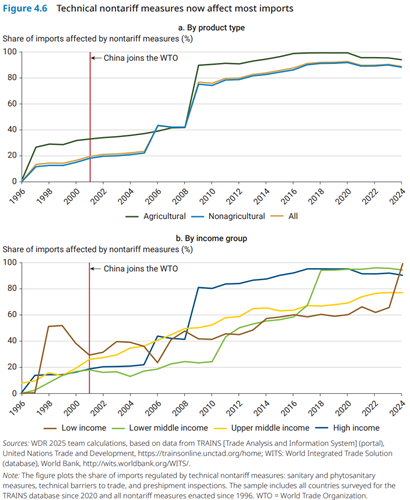
3. The report notes that nearly 90% of world trade is now shaped by nontariff measures, most linked to standards. How do standards influence international trade and competitiveness, especially for developing economies?
Standards influence trade and competitiveness in two opposing ways:
- On the positive side, they reduce transaction costs by creating a common language between buyers and sellers. A certified product signals to an importer that it meets agreed specifications without the need for costly individual verification. Standards also enable firms in developing countries to plug into global value chains: adopting international standards can open doors to higher-value export markets and attract foreign investment. In fact, the report finds that firms that adopt standards grow faster and export more. Crucially, the sales premium from certification is highest for firms in low- and middle-income economies, where standards help credibly signal quality to foreign buyers.
- On the negative side, standards can function as barriers, especially when they are numerous and designed without developing-country realities in mind. The report finds that technical nontariff measures generally reduce exports from developing countries and that low- and lower-middle-income exporters face significantly higher product refusal rates in EU and US markets. Compliance costs fall disproportionately on smaller firms, and the proliferation of overlapping private standards alongside public regulations compounds the burden. A further asymmetry is that developing countries are largely absent from the international committees where these standards are set, meaning they must comply with rules they had little hand in shaping.
Whether standards act as a bridge or a barrier ultimately depends on two factors: a country's capacity to meet them, and its voice in writing them.
4. The report highlights that many developing countries are under-represented in international standard-setting bodies. What can European and international standardization organizations do to help level the playing field?
European and international standardization organizations can act on several fronts, and some meaningful action has already been taken. ISO's sponsorship programme funds delegates from eligible developing countries to attend committee meetings linked to national priorities. Some international standards bodies offer fellowships and tailored training for standards newcomers. Twinning programmes that link national standards bodies from high-income countries with those in low- and middle-income countries help build the capacity needed to participate meaningfully in technical committees. Virtual participation in committee meetings has reduced travel costs.
There is clear potential to scale up these existing activities. The gap remains enormous, and greater funding, broader reach, and sustained technical support, particularly for the least developed countries, would go a long way toward closing it.
But levelling the playing field is not only about getting more people into the room. It is also about changing the way international standards are written. Our report speaks in favour of a tiered approach: designing standards with graduated levels of stringency from the outset, so that countries and firms at different capacity levels have a clear pathway to compliance rather than facing a cliff they cannot scale.
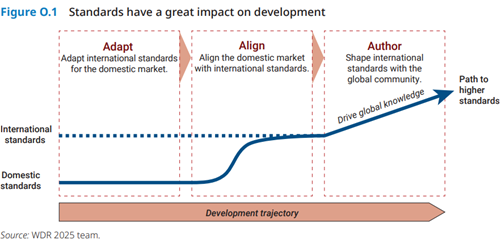
The EU's vehicle emissions standards moved from Euro 1 through Euro 7 over three decades, and China and India followed the same tiered trajectory. Rwanda's Standards Board introduced a maturity model helping small enterprises progressively meet international standards. Embedding this kind of graduated design into international standards, rather than expecting all countries to meet the same bar on day one, would do at least as much to level the playing field as expanding participation.
5. The report also points to an imbalance: too many standards in some areas and too few in others. How can policymakers and standard-setters address this challenge without stifling innovation or market access?
The report shows that policymakers should use the full toolbox of standards as policy instruments, not just the ‘hammer’ of mandatory regulation. Voluntary standards, typically led by industry, spread good practice in flexible ways and can respond quickly to technological change.
Mandatory standards are appropriate where uniform compliance is needed to prevent substantial harm, such as in construction safety, food contamination or nuclear energy. In most cases, regulation should set the broad outcomes society cares about, and leave the technical details of how to achieve them to voluntary standards. This is the model the EU has long practiced through its New Legislative Framework approach, and it is the logic underpinning many of its priority pieces of legislation. An example of this is the Artificial Intelligence Act, where it makes risk management mandatory for high-risk systems but leaves technical specifications to voluntary standards.
The report also provides clear guidance on when and how to use standards in regulation. Cost-benefit analysis should be systematically conducted before making standards mandatory and used for evaluation after they are introduced. A proper cost-benefit analysis weighs direct benefits like improved health and safety against compliance and enforcement costs, but it also requires difficult value judgements: how to price non-monetary damages such as loss of life, how to discount the future against the present, and where to draw the boundaries of analysis.
Combining voluntary standards with regulation is ultimately the key to achieving innovation-friendly policy. Laws define the outcomes; standards define the technical pathways. This keeps regulation current as technology changes, allows fast-track updates to referenced standards without excessive legislative churn, and gives firms the flexibility to innovate within a clear framework. Getting this balance right, rather than simply adding more rules, is how policymakers can address the imbalance without stifling innovation or closing off market access.
6. Standards only work if they are supported by strong quality infrastructure, such as metrology, testing, certification, and accreditation. Why is this infrastructure so critical for development outcomes?
In many cases, a standard depends on verification. For example, a food safety standard that limits aflatoxin contamination in milk means nothing if there is no laboratory capable of testing for it. The same logic applies across sectors: an emissions standard requires measurement equipment that can detect pollutants at specified thresholds; and a pharmaceutical standard requires laboratories that can confirm the composition and dosage of medicines. Without this verification chain, standards remain aspirational statements rather than enforceable rules.
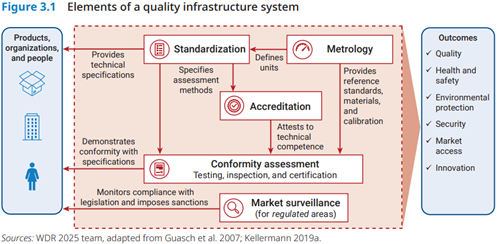
This is why quality infrastructure underpins both competitiveness and regulation. For firms, accredited testing and certification provide the credible signal that foreign buyers and regulators require. For governments, quality infrastructure makes regulatory enforcement effective and efficient. Our report documents that countries with stronger quality infrastructure tend to perform better economically, and that the benefits flow to firms, markets, and the public alike, from lower transaction costs to stronger consumer protection.
Quality infrastructure is also critical because the demands of international markets keep rising. Importing countries are requiring ever more precise measurements of contaminants in food, stricter tolerances on industrial components, and more rigorous verification of sustainability claims. Measuring pesticide residues on fruit down to the last microgram, as some advanced-economy regulations now require, demands laboratory capacity and internationally recognized accreditation that many developing countries simply do not yet have. Without laboratories that can perform these measurements and whose results are accepted by trading partners, meeting the bar is extremely difficult. Building this infrastructure takes time, sustained investment, and logical sequencing: metrology underpins standards, which enable testing and certification, with accreditation following to ensure the credibility of the entire system.
7. How can governments avoid treating standards as a technical afterthought and instead leverage them as a strategic tool?
It starts with higher-level awareness by policymakers. Standards cut across trade, industrial development, health, environment, and finance, which means they require coordination across many government bodies. When standards are left solely to technical agencies operating in isolation, they rarely feature in national development strategies.
One key step is integrating them into broader industrial and trade policies, as Japan, Korea, and China all did during their periods of rapid economic transformation. In each case, standards were treated not as a compliance burden but as a strategic instrument for technological upgrading, export competitiveness, and productivity growth.
Concretely, governments should create the conditions for firms to upgrade quality through incentives, procurement signals, and access to finance, rather than simply mandating standards that firms cannot meet. They should invest in quality infrastructure sequenced to national priorities and market demand. And they should participate actively in international standard-setting forums, focusing on sectors with the highest export potential.
8. What is the biggest misconception about standards that needs correcting?
Three misconceptions stand out. First, that standards equal regulation. Most standards are voluntary, developed by industry to spread good practice. Governments make some mandatory when public safety demands it, but conflating the two leads to over-regulation or underuse.
Second, that standards are technical details that could be left to technical experts. The report shows that decision makers should care about standards too. The countries that industrialized fastest treated standards as core economic policy, not paperwork.
Third, that adopting standards alone creates trust. It does not. Without functioning quality infrastructure to verify compliance, many standards remain words on paper.
9. What piece of information surprised you the most while working on the report?
First, that nearly 90 percent of global trade is now shaped by technical non-tariff measures, up from 15 percent in the late 1990s. Tariffs get the headlines, but standards-related measures are the real gatekeepers.
Second, the sheer tilt in participation in international standardization. Low-income countries sit on 7 percent of ISO technical committees; high-income countries on 84 percent. The rules are being written in rooms where most developing countries are barely present.
Third, how thin the evidence base on standards is. Given how much standards matter for trade, health, and industrial policy, there is remarkably little robust data on their economic and social impacts, so it is key to close this gap.
10. Finally, what’s the one thing you hope readers take away from the WDR 2025?
That standards are an exciting topic that more people should care about!