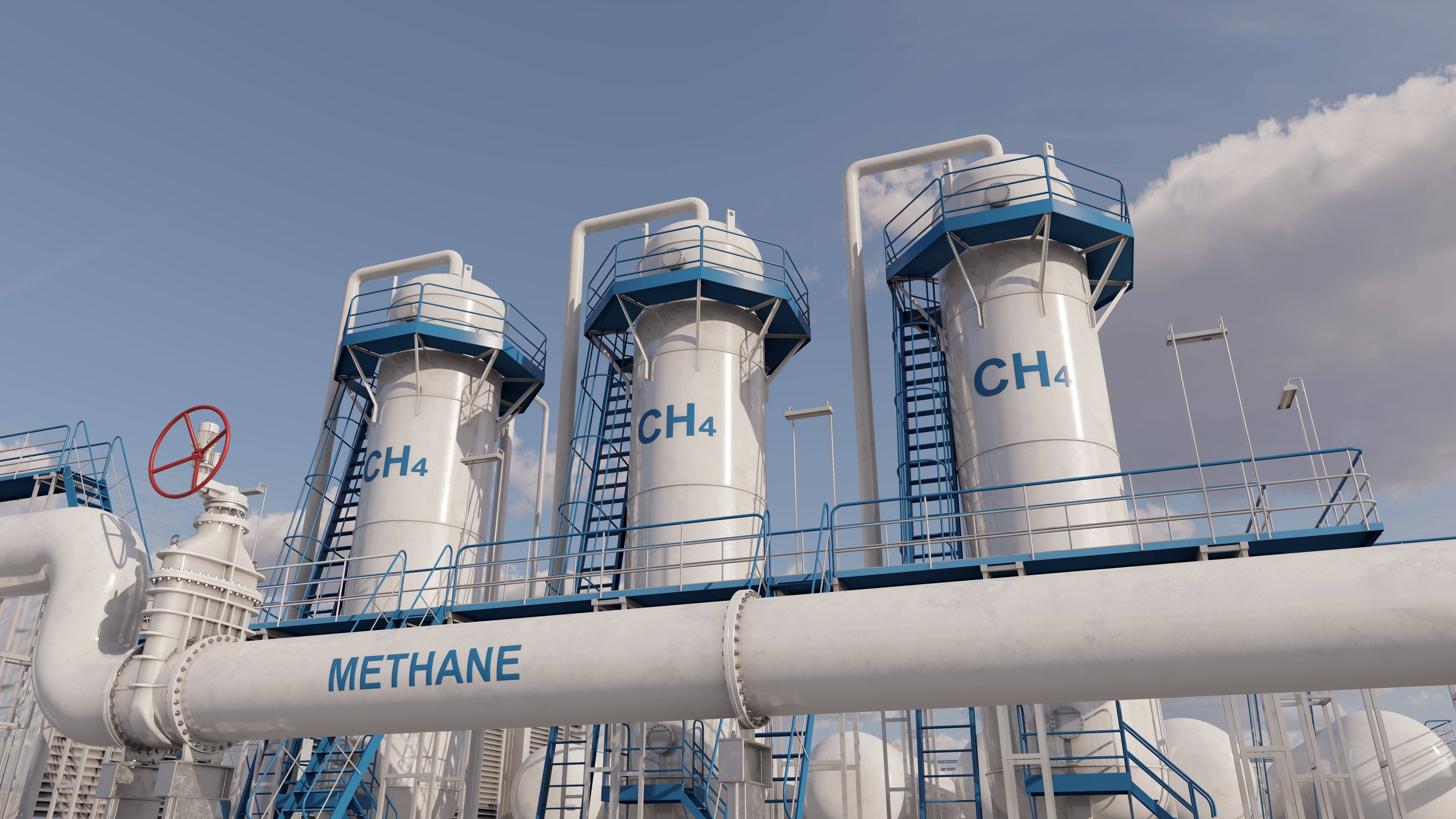
Methane (CH4) is the second most important Greenhouse Gas (GHG) contributor to climate change. 60% of the global methane emissions result from human activity, 1/3 of which is generated in the energy sector. To address the climate change challenge, the European Union has adopted Regulation (EU) 2024/1787 on the reduction of methane emissions in the energy sector, which sets ambitious requirements applicable to the oil and fossil gas infrastructures in Europe. Considering that the EU imports most of its oil and fossil gas, Regulation (EU) 2024/1787 also addresses methane emissions occurring outside the EU, with respect to crude oil and natural gas (the main component of which is methane) placed on the EU market.
Greenhouse Gases
The greenhouse gas effect raises atmospheric temperatures because certain gases absorb infrared radiation and convert it into heat. This capacity is known as Global Warming Potential (GWP).
The most famous greenhouse gas is carbon dioxide (CO2), but several other gases also have a Global Warming Potential (GWP) and are categorized by the United Nations with a reference to CO2. According to the Sixth Assessment Report of the United Nations Intergovernmental Panel for Climate (UN IPCC AR6, 2020), the methane GWP value over a 100-year horizon is equal to 27,0 for non-fossil CH4 and 29,8 for fossil CH4. Therefore, the impact of fossil CH4 on global warming is 29,8 times stronger than the impact of the equivalent quantity of CO2. This clearly highlights the importance of reducing methane emissions.
CH4 emissions of oil and gas installations in a nutshell
In the energy sector, methane emissions from oil and gas installations can occur in many different circumstances. They may result from large-scale events, such as major accidents, or from very small releases, such as micro-leaks in components or permeation through the tubes carrying the gas.
In some cases, methane emissions are an inherent part of the operational process, such as gas actuators used to open and close valves, natural gas turbine purging sequences or flaring. The emissions may also result from safety measures, such as venting, applied to maintain infrastructure integrity under specific operating conditions.
This diversity shows that methane emissions from oil and gas installations can vary greatly in scale and context. As a result, detection and mitigation approaches must be tailored to specific situations, as no single solution can address all cases.
Over the past decade, the oil and gas industry has made significant progress in detecting, measuring, monitoring, and reducing methane emissions across its infrastructure. Operators, in cooperation with different partners (including academia, laboratories, and manufacturers), have carried out numerous measurement campaigns to better understand leak behaviour and improve detection and quantification methods and systems. New equipment and operating procedures have also been developed and implemented at oil and gas installations to reduce emissions wherever possible while maintaining safety levels. Reporting methods and actual-emission quantification have been further developed to support a transparent and consistent EU-wide approach and help ensure effective contributions to overall emission reduction. This work has been coordinated by the United Nations Environment Programme (UNEP) and the industry through the Oil & Gas Methane Partnership 2.0 (OGMP 2.0), the flagship UNEP oil and gas reporting and mitigation programme.
Standardization work
Standardization work has already begun at the European and international level through two EU-funded projects. The EISMEA project ‘ME gas’, launched in 2023, covers midstream fossil gas activities, including gas transmission and distribution systems. In 2024, the European Commission also funded standardization work in collaboration with ISO on upstream emissions from oil and gas exploration, production, and processing through the ‘ME-OIL-UPSTREAM-GAS’ project.
Through Regulation (EU) 2024/1787, the European Union considers European and international standards as part of the solution to define methods to detect, monitor, quantify, and mitigate methane emissions from the energy sector.
In July 2026, CEN accepted the EU Standardization Request (M/624) as regards methane emissions quantification and mitigation – part 1: crude oil and natural gas and allocated the work to CEN/TC 12 ‘Oil and gas industries including lower carbon energy’, CEN/TC 234 ‘Gas infrastructure’, and CEN/TC 264 ‘Air quality’.
Included in the Standardization Request, two standards will be developed on Leak Detection and Repair (LDAR) activity for methane. Their scope will cover upstream oil and gas activities, as well as midstream gas installations, including high-pressure transmission grids, low-pressure distribution grids, gas storage facilities, and Liquefied Natural Gas (LNG) terminals.
Two additional standards will address the reduction of methane emissions from venting and flaring in the oil and fossil gas sectors and will address the selection of the appropriate equipment design as well as the definition of operational best practices.
Another standard is supposed to define methodologies for methane emissions detection, monitoring, measurement/quantification, and reporting for oil and fossil gas exploration and production, for fossil gas gathering, processing, and liquefaction, as well as for inactive wells, temporarily plugged wells, and permanently plugged and abandoned wells. Symmetrically, the midstream sector will benefit from a methodology standard about the measurement/quantification for gas transmission and distribution systems, underground gas storage, and LNG regasification facilities.
The EU established the International Methane Emissions Observatory (IMEO) in partnership with UNEP to collect, reconcile, verify and publish global data on anthropogenic methane emissions. Future CEN standards will support the quantification of emissions data and structure reporting activities to provide IMEO with the necessary information.
Under Article 32 of Regulation (EU) 2024/1787, once published and assessed as compliant by the European Commission, these standards will be made mandatory for the oil and gas industry by the adoption of delegated acts to supplement Regulation (EU) 2024/1787.
Benjamin de VILLE de GOYET
bdeville@cencenelec.eu


