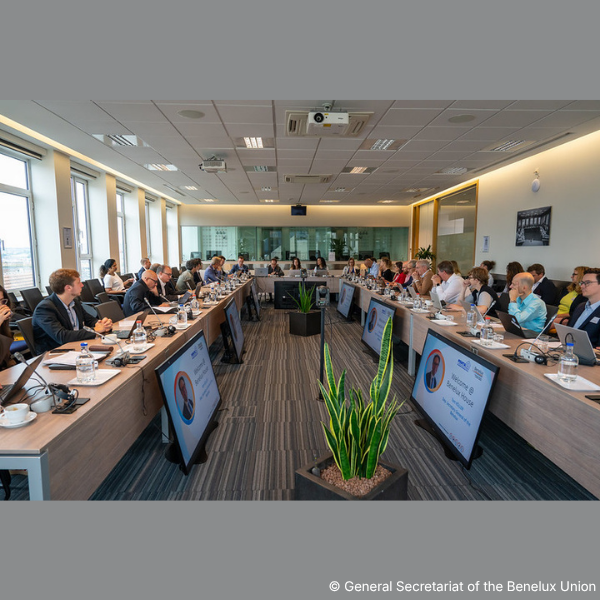
How can Europe enable consumer-side flexibility at scale? This question was at the heart of a workshop organized by the Pentalateral Energy Forum (PENTA), the High-Level Forum on Standardization, and CEN and CENELEC at the Benelux House in Brussels
The Pentalateral Energy Forum brings together Austria, Belgium, France, Germany, Luxembourg, the Netherlands, and Switzerland in one of Europe’s long-standing regional cooperation platforms that translates shared energy policy objectives into practical cross-border action. Since its establishment in 2005, PENTA has translated regional cooperation into concrete results, including pioneering flow-based day-ahead market coupling, advancing coordinated regional adequacy assessments, and developing common approaches to electricity crisis preparedness.
Need for Coordination
In this context, the workshop was organized to examine how standardization, data interoperability, and market design can support the activation of consumer-side and distributed flexibility resources. The workshop brought together perspectives from the European Commission, system operators, standardization bodies, market participants, and the end-consumer.
The workshop showed that enabling flexibility at scale is complex and requires the involvement of many actors across the flexibility value chain. Making flexibility technically possible is only one part of the challenge. While standardization plays a key role, it needs to be complemented by regulatory and organizational interoperability, including clear roles, responsibilities, and governance. At the same time, any framework should be sufficiently robust to support deployment, while remaining adaptable to innovation, as not all future use cases can be anticipated today.
A central message was that flexibility needs in the electricity system are increasing. The forthcoming Network Code on Demand Response was presented as an important instrument to address barriers such as market design, prequalification, digital infrastructure, system operator coordination, and planning. To be effective, it will need to be supported by coherent implementation and coordination across national frameworks.
Participants discussed different ways of activating flexibility, including implicit flexibility, for example through dynamic tariffs and explicit flexibility through participation in balancing and ancillary services, flexibility markets, rules-based mechanisms, and flexibility procurement by system operators. The need for coordination between Transmission System Operators (TSOs) and Distribution System Operator (DSOs), and between different procurement mechanisms, was repeatedly underlined. Participants also stressed that these mechanisms require robust and standardized data exchange between relevant actors, including system operators, aggregators, suppliers, and consumers. Ensuring appropriate data protection and governance remains a cornerstone.
Distributed Flexibility in Practice
Data exchange and governance were identified as key enablers. The discussion highlighted the need for common rules, procedures, roles, responsibilities, testing, verification, and trust. Standardized APIs and practical interoperability rules were discussed as ways to reduce complexity and support scalability, especially for assets such as electric vehicles, heat pumps, batteries, and energy management systems.
From the market participant perspective, it was stressed that flex-ready products alone are not sufficient if consumers cannot actually use them in a flexible way. Product readiness therefore needs to be linked with market access, tariff structures, and system operator needs.
Regional Cooperation
Building on the discussions in the workshop, PENTA will continue working along the lines identified during the exchange and where regional coordination can bring added value, in particular on the coordinated implementation of consumer-side flexibility, data exchange, interoperability, standardization, and coordination across the flexibility value chain. The aim is to reduce fragmentation and enable market participants across the value chain to offer flexibility services more easily within the PENTA region, with lower transaction costs and fewer country-specific barriers.
Find out more about the Coordination Group on the All-Electric Society and our work in the energy sector.
Yves LEBOUCHER
yleboucher@cencenelec.eu


