Innovation is often associated with breakthrough technologies, disruptive business models, and visionary entrepreneurs. Yet the ability to transform an idea into a commercially successful product or service depends on something far less visible: the infrastructure that enables innovation to scale.
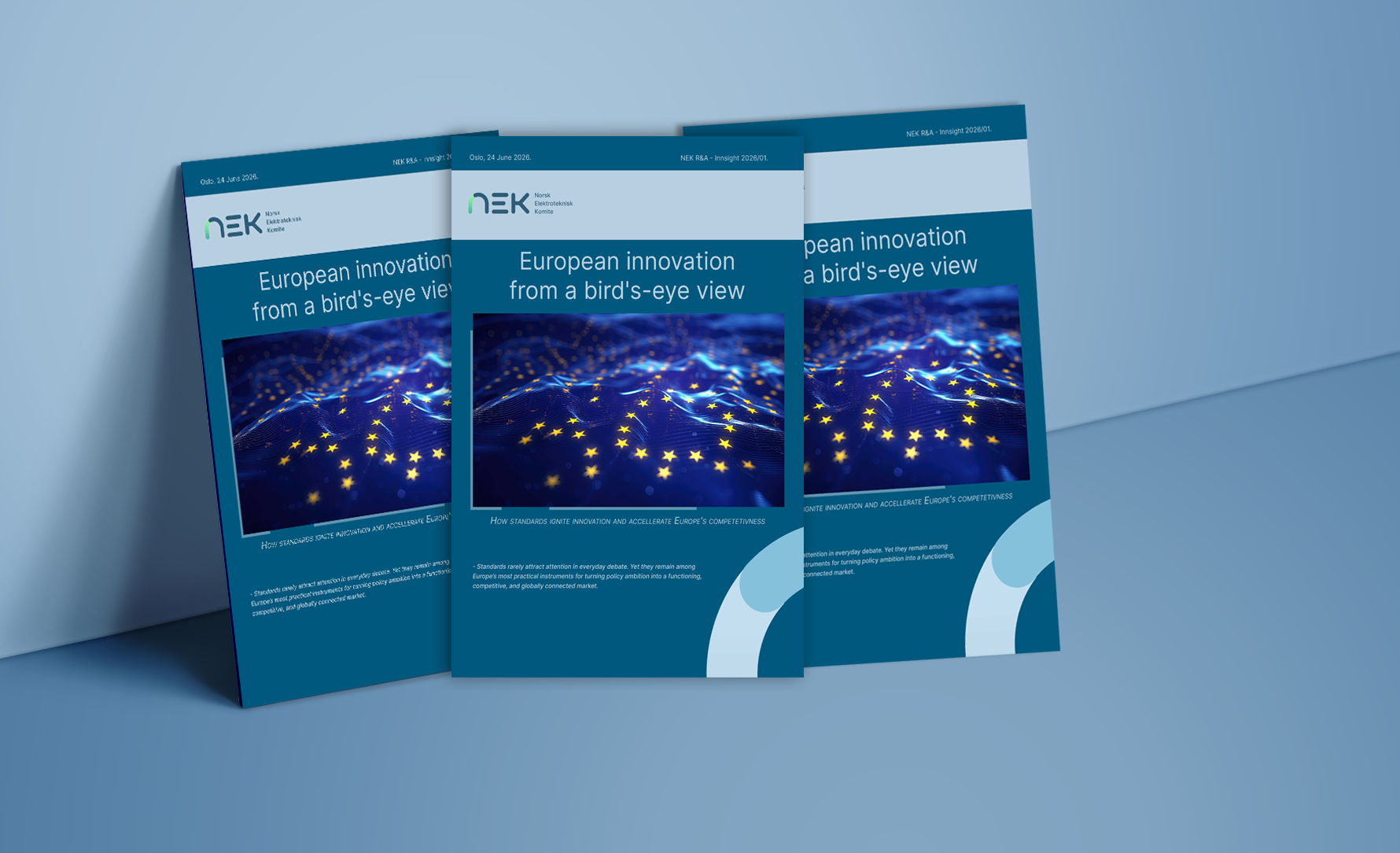
This is the central message of NEK’s report, European Innovation from a Bird’s-Eye View.
The report argues that standards are among Europe’s most important—and most overlooked—strategic assets. They form part of the technical infrastructure that allows products, services, and systems to function across borders, industries, and value chains. In doing so, they help transform technological potential into economic value.
At a time when Europe is striving to strengthen its competitiveness, accelerate the green and digital transitions, and maintain technological leadership in an increasingly fragmented world, understanding the role of standards has never been more important.
Innovation Thrives on Shared Foundations
A key concept explored in the report is NEK’s “90/10 metaphor”. The metaphor challenges the common perception that innovation begins with a blank sheet of paper. In reality, most successful innovations build upon an extensive foundation of existing technologies, safety practices, interfaces, regulations, and technical knowledge. Only a relatively small portion of new products or services is genuinely new.
This foundation is where standards create value. By providing common technical frameworks, standards eliminate the need for companies to repeatedly solve the same compatibility, safety, and integration challenges. Instead of reinventing existing solutions, organizations can focus their resources on differentiation, customer value, and technological advancement.
In this sense, standards do not compete with innovation. They enable it.
The Hidden Enabler of Market Access
For businesses, one of the most significant benefits of standards is their role in facilitating market access. Europe’s Single Market is one of the world’s largest economic areas. Its success depends on products and services being able to move across borders without encountering unnecessary technical barriers.
Standards make this possible.
They provide a common technical language that is understood and accepted throughout the market. Manufacturers, service providers, regulators, testing laboratories, and customers can work from the same set of expectations regarding safety, performance, interoperability, and compliance.
The result is a more predictable business environment, lower transaction costs, and faster market entry. For innovative companies, this can be the difference between developing a promising technology and successfully scaling it across Europe and beyond.
Interoperability Creates Economic Value
In today’s economy, innovation rarely succeeds in isolation. Electric vehicles depend on charging infrastructure. Renewable energy systems interact with power grids. Digital services exchange information across platforms and organizations. Industrial systems rely on data flowing seamlessly between multiple technologies.
The value of any single innovation increasingly depends on its ability to work with others. This is why interoperability has become a strategic issue. The report highlights how standards provide the common interfaces, protocols, and data structures that allow technologies to communicate and operate together. This creates value throughout the entire ecosystem.
Businesses gain access to larger markets because their solutions integrate more easily with existing systems. Customers benefit from greater choice and reduced vendor lock-in. Investors gain confidence in technologies that can be adopted at scale. Society benefits from more efficient, secure, and resilient infrastructures.
Interoperability is therefore far more than a technical requirement—it is a prerequisite for modern economic growth.
Accelerating the Journey from Innovation to Scale
One of the most challenging stages in any innovation process is the transition from development to widespread adoption. Many promising technologies fail not because they lack technical merit, but because they struggle to gain market acceptance, demonstrate compliance or integrate into existing ecosystems. Standards help overcome these barriers.
By providing recognized methods for testing, verification, and performance assessment, standards create confidence among customers, regulators, investors, and supply-chain partners. They reduce uncertainty and make it easier to evaluate, adopt, and scale new technologies.
This role becomes increasingly important in emerging sectors such as artificial intelligence, cybersecurity, clean energy, smart infrastructure, and digital services, where trust and interoperability are essential for market growth.
The report therefore presents standardization not as a downstream activity that follows innovation, but as a strategic enabler throughout the innovation life cycle.
Connecting Policy Ambitions with Market Reality
The report also highlights the unique role of standardization within Europe’s regulatory model. Public policy establishes objectives. Regulation defines requirements. Standards provide practical, technical solutions that make implementation possible.
This division of responsibilities has become one of Europe’s competitive strengths. It enables policymakers to establish long-term goals while allowing technical solutions to evolve alongside technological progress. It also creates a mechanism through which industry expertise can contribute directly to the practical implementation of policy objectives.
For businesses, this results in greater predictability and clearer pathways to compliance. For policymakers, it offers an effective mechanism for translating political ambition into real-world outcomes. In an era of rapid technological change, this flexibility is increasingly valuable.
A Strategic Asset for Europe’s Future
The report’s overarching conclusion is clear: standardization should not be viewed merely as a technical process. It is a strategic capability.
Standards reduce market friction. They enable interoperability. They support regulatory compliance. They accelerate innovation. They strengthen trust. And they help European companies compete in both regional and global markets.
Perhaps most importantly, they provide the shared foundations upon which innovation ecosystems can grow and thrive.
As Europe seeks to strengthen its competitiveness, technological sovereignty, and economic resilience, standards will continue to play a critical role in shaping the continent’s future.
European Innovation from a Bird’s-Eye View offers a timely reminder that innovation does not happen in isolation. It succeeds when ideas can move efficiently from laboratories to markets, from prototypes to scale, and from local solutions to international adoption.
Standards make that journey possible. That is why they deserve recognition as one of Europe’s most important and underrated strategic infrastructures.
Follow the link for downloading European Innovation from a Bird’s-Eye View free of charge.