A child seat that fits properly, a desk that supports a comfortable posture or protective equipment that allows freedom of movement all depend on good design decisions. These decisions require reliable data, but also an understanding of how factors such as age, posture, clothing and movement affect children’s dimensions in real-life situations. CEN/TS 18296-2:2026 bridges this gap, helping turn anthropometric and strength data into safer, more comfortable and more user-friendly products and environments for children.
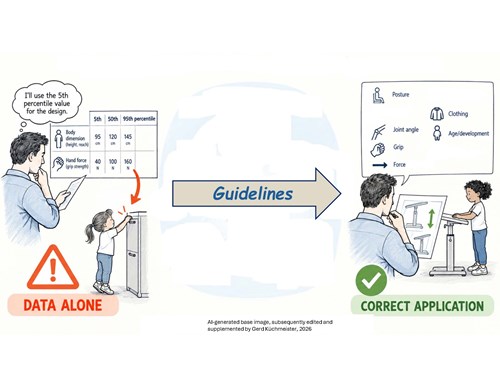
The recently published CEN/TS 18296-2:2026 provides guidance on the correct application of anthropometric and strength data for children in Europe. It accompanies the updated statistical data published in CEN/TR 18296-1:2026 and helps users translate measured body dimensions and strength values into practical design and assessment decisions. The Technical Specification combines anthropometric core data with information on biological and interface-related factors that can affect measurements in real-life situations. A graphical toolbox uses icons to draw attention to relevant influences such as posture, movement, clothing, protective equipment and contact with products or other technical environments.
What changes
Previously, users could rely on statistical tables but did not always receive sufficient guidance on how the values should be interpreted in a specific application. CEN/TS 18296-2:2026 introduces a user-driven approach that links the data to application notes and a visual system of icons. It distinguishes between core data, biological transfer data and interface transfer data, thereby making factors that can modify a measured value more transparent. The document therefore moves beyond the provision of anthropometric data alone and supports their informed application in design, standardization and product assessment.
The importance of the Technical Specification
Children’s body dimensions and physical capabilities differ significantly according to age and development, and measured values cannot always be transferred directly to a real-life situation. Posture, movement, soft tissue, clothing, protective equipment and interaction with a product may all affect the dimensions that need to be considered. Misinterpreting anthropometric data can therefore lead to products or environments that do not adequately address children’s safety, comfort or usability. The Technical Specification helps reduce this risk by explaining the relevant influences and making them visible at the point where the data are used.
Benefits for industry and society
The Technical Specification gives product designers, manufacturers, testing bodies and standards developers a common basis for applying children’s anthropometric and strength data. Better interpretation of the data can support safer, more comfortable and more user-friendly products and technical environments for children. It can also improve the consistency and quality of product assessment and comparative testing. Society benefits when children’s physical diversity is taken into account more systematically in products, services and environments that children use or encounter in everyday life.
The guidance can be applied to products actively used by children, such as toys and children’s vehicles, as well as furniture, bedding and school equipment. It is also relevant to pushchairs, child restraint systems, protective equipment, footwear, technical medical products and the design of public or built environments. Designers can use it when selecting appropriate body dimensions, percentile values and strength data for a defined group of children. The information can also support computer-aided design, digital human models, product testing and the development or revision of standards.
Practical examples
A designer developing a child seat can use the data and guidance to determine suitable dimensions for the seat, restraint system and surrounding space. The Technical Specification reminds the designer that measurements taken in a standardized posture may change when the child is seated and that allowances may be needed for clothing or protective equipment. It also highlights how contact with the seat can compress or displace soft tissue and thereby affect the effective dimensions. Taking these factors into account can help create a seat that accommodates a wider range of children and provides better comfort and protection in everyday use.
A webinar was recently dedicated to this topic. The recording, presentation and Q&A are available here.

Ardit Cami
acami@cencenelec.eu


