The European Union has ambitious environmental objectives defined in its legislations. As the products brought on the European Single Market have a significant environmental impact, the European Union decided on a mandatory Digital Product Passport (DPP) to store the circularity data of products for various product groups. Since products brought on the European Single Market have a significant environmental impact, it is necessary to know the parameters of each product and to exchange circularity and sustainability information with all stakeholders.
To support the exchange of reliable product data, a robust system must be implemented at the European level, while also considering all necessary interactions with industries outside the EU that do business with the Union.
European Context
In this context, the Joint CEN and CENELEC Technical Committee 24 ‘Digital Product Passport - Framework and System’, whose Secretariat is held by the German Institute for Standardization (DIN), developed the first series of 8 European standards to cover the essential aspects that are needed to implement the European Digital Product Passport required by the Ecodesign for Sustainable Products Regulation (EU) 2024/1781, also known under the acronym ESPR.
With strong momentum given by the European Union’s Standardization Request M/604, CEN-CLC/JTC 24 set the foundation for a robust, reliable and interoperable DPP framework to be used by all product segments across and outside the EU when a product is put on the European Single Market.
The Role of the DPP
The DPP is often seen as simply a traceability and compliance tool, but it is much more than that: it creates a lot of possibilities and opportunities for all market players far beyond the implementation of the legal sustainability requirements. The European DPP is a game changer.
The tool reduces administrative burdens and improves the exchange of data, enhancing the efficiency of businesses in Europe. At the same time, it is the vector to implement the circularity principles on the EU Single Market.
The DPP is also a tool that will interconnect different European Regulations linking different sectors. The potential for synergies is significant.
Interoperability is Key
The European DPP is of course not the first DPP to be developed, and the idea behind M/604 was not to restart from scratch. Many databases of different industries already exist around the world, gathering a massive amount of usable high-quality data. To speed up the implementation of the DPP in Europe, CEN-CLC/JTC 24 experts and EC Policy Officers decided to design a system that allows the integration of the already existing DPPs by focusing their attention on the interoperability aspect. In addition, standardization aims to describe the state-of-the-art in each domain and, as for other sectors, CEN-CLC/JTC 24 goes in line with existing European and international standards, via the principle to create normative references in its standards.
The European DPP is European by its name, by its origin, but it is in fact a global tool. To create synergies among all existing databases, the concept of interoperability between various DPPs is of great importance: multiple DPPs will have to communicate with each other. To ensure interoperability, stable and clear definitions and semantics are essential elements for smooth and reliable operations among all stakeholders.
Globally, the International Standardization Organizations are following the European example, and CEN-CLC/JTC 24 is looking forward to a fruitful collaboration with its mirror committee ISO/IEC JTC 5 ‘Digital Product Passport’, which was recently created at the international level.
Hybrid Structure
The European DPP is not a centralized database, but at the same time, it is also not fully decentralized. To operate such a gigantic system, the Member States decided to create an unusual hybrid structure (Figure 1, below) where the responsibilities are split between the EC and several Third-Party Service Providers. The European Commission will be responsible for operating a registry, where the IDs of the products, the manufacturers and the factories are stored. However, the operational management of the product data and their storage, including a long-term backup, will be delegated to Third-Party Service Providers, which are usually private companies.
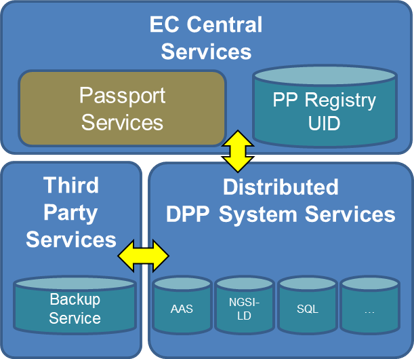
Figure 1 – The European DPP structure
Risk Management
Given the central role of the DPP for the implementation of sustainability and circularity principles for the European industry, it is essential to identify and mitigate the risks that are directly linked with the management of data. Ensuring trust in the data quality is a pivotal element for such a system to succeed.
The access to the stored data will be regulated by the concept of legitimate interest to protect confidential business information or personal data. The Commission will adopt implementing acts defining which natural or legal persons have a legitimate interest in accessing and processing that information for specific purposes. The CEN and CENELEC DPP standards define how to ensure that the legitimate access principle is duly implemented in all DPPs, considering various possible scenarios in the different sectors.
An improvement of the market as regards circularity and sustainability implementation requires a close monitoring of the evolution of industrial practices. This must be done with a long-term perspective, far beyond the normal lifetime of a product, as parts of products can be recycled and reused in other products, which requires an extension of the monitoring. Therefore, the DPP infrastructure must ensure to include a robust archive of product data and data persistence.
The CEN-CLC/JTC 24 standards represent the state-of-the-art considering these risks and provide the users with operational solutions to mitigate them. This makes the DPP system reliable, trustworthy and ready to operate with a high level of integrity.
What to Expect from CEN-CLC/JTC 24 Standards
The DPP standards, as developed by CEN-CLC/JTC 24, are transverse and product agnostic and aim to be used as a framework for the whole product value chain, product category per product category.
The different European product regulations will define case by case which data will be stored and exchanged via the different product DPPs. Hence, the European Union defines the legal requirements for each product through legislations, and European standards specify the best method to define or calculate the product data that must be stored in the different DPPs.
Therefore, each part of the following set of standards is necessary to implement a DPP system in an efficient way.
- EN 18216 ‘Digital product passport - Data exchange protocols’
- EN 18219 ‘Digital product passport - Unique identifiers’
- EN 18220 ‘Digital product passport - Data carriers’
- EN 18221 ‘Digital product passport - Data storage, archiving, and data persistence’
- EN 18222 ‘Digital Product Passport - Application Programming Interfaces (APIs) for the product passport lifecycle management and searchability’
- EN 18223 ‘Digital Product Passport - System interoperability’
- EN 18239 ‘Digital Product Passport - Access rights management, information system security, and business confidentiality’
- EN 18246 ‘Digital product passport - Data authentication, reliability and integrity’
Last but not least, the development of this series of harmonized standards has been undertaken by CEN-CLC/JTC 24 under the EC standardization request M/604 to support the ESPR, and six (out of eight) standards have already been cited in the Official Journal of the European Union. Why is the citation of standards so important? In practice, once a harmonized standard is cited in the OJEU, its correct application provides the DPP with the presumption of conformity to the corresponding legal requirements set by the ESPR and thus helps organizations to demonstrate compliance more efficiently and with greater legal certainty.
What Not to Expect from CEN-CLC/JTC 24 Standards
Given the extremely large number of products covered by the ESPR, in 2025, the European Commission released its 5-year ESPR Work Plan 2025-2030, where priorities have been established on which end-use products, which intermediate products, and which new Ecodesign requirements to develop. Different product legislations are currently in preparation specifying the mandatory data to be recorded in the DPP as well as the Ecodesign requirements that apply for each category of product.
Consequently, CEN and CENELEC expect to receive Standardization Requests asking for the development of standards by the responsible product Technical Committees for each product group, with the goal of describing test methods that the industry is supposed to use to establish the product data stored in the DPPs.
Where To Find CEN-CLC/JTC 24 Standards
Organizations looking to implement compliant Digital Product Passports can obtain the standards through their National Standardization Body.
Who Should Be Interested in the European DPP?
The European DPP is important for everyone! It is relevant for authorities, market surveillance authorities, borders authorities, manufacturers, consumers, recyclers, repairers, as well as third-party service providers.

Benjamin de VILLE de GOYET
bdeville@cencenelec.eu


