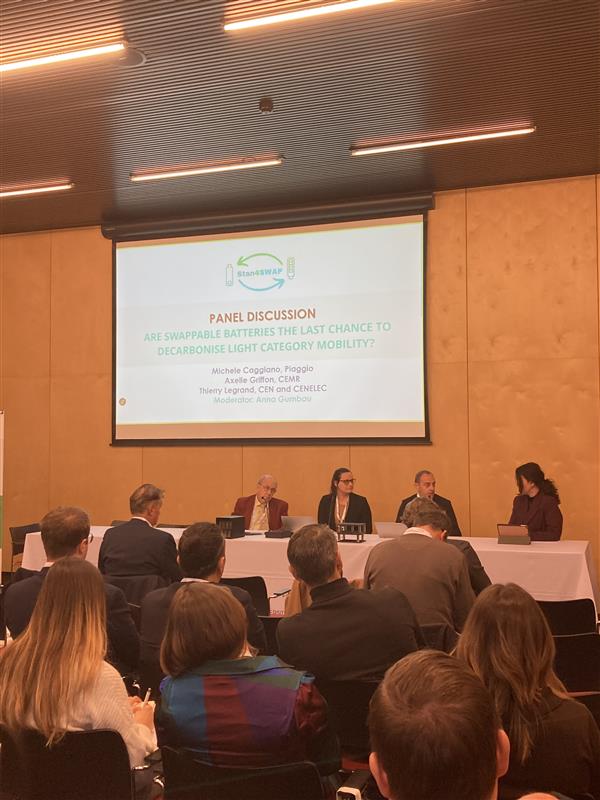
On 19 November, the Horizon Europe funded project Stan4SWAP marked the project’s final event. The event was opened by MEP Pierfrancesco Maran and brought together industry experts, researchers, policymakers, and city representatives to discuss how swappable batteries for light-category electric vehicles (L-cat EVs) can support Europe’s transition to sustainable urban mobility.
The background of the discussion was two years of efforts to develop a roadmap for the standardization of swappable battery systems for light-category electric vehicles. The introduction was given by the project coordinator, Enrico Mayrhofer from Piaggio, and followed by a presentation of the current state of play in standardization and regulation by Professor Peter van den Bossche from VUB.
The event emphasized the growing pressure from pollution and congestion that cities are faced with and to which light electric vehicles, powered by swappable batteries, can provide an efficient, space-saving, low-emission alternative. As such, swappable batteries address two major barriers to EV uptake: long charging times and range anxiety by enabling instant “refuelling” at swapping stations.
However, to reap the many benefits of swappable battery systems, standards are needed. The analysis of the market state of the art, which was presented ahead of the roadmap, showed a fragmented marked with batteries varying greatly in size, shape, electrical interface, capacity, communication protocols, and safety features, preventing interoperability across brands or regions. This analysis was presented by Michele Perani from Hyba, followed by a presentation of market needs as well as the needs for pre-normative research towards standardization, presented by Tim Wicke from Fraunhofer ISI, Ludwig Speidel from Swobbee, and Karl-Maria Grugl from KTM.
The launch of the roadmap was executed by Bernard Gindroz from BMGI, who presented its structure and main conclusions. The roadmap is structured around four domains, namely: battery pack, vehicle, infrastructure, and interfaces. It identifies gaps and proposes short-, medium- and long-term actions, including:
- harmonizing vehicle type-approval rules to accommodate standardized batteries,
- developing unified communication and data-exchange protocols,
- defining risk models and fire-safety requirements for swapping stations,
- enabling modular battery design to future-proof systems, and
- leveraging swapping stations for smart-grid and storage services.
After the presentation, a panel consisting of Michele Caggiano, Innovation manager and Vice President at Piaggio, Axelle Griffon, Senior Policy Advisor – Environment & Mobility at CEMR, and Thierry Legrand, Account Manager Mobility at CEN and CENELEC, discussed the potential of swappable batteries and the Stan4SWAP roadmap to support Europe’s transition to sustainable urban mobility. Among all panellists, there was strong consensus that swappable batteries represent a promising and potentially transformative solution for urban electrification, but only if Europe acts quickly to establish interoperable standards, harmonized regulations, and supportive infrastructure policies will it be possible to benefit from the technology. With these in place, widespread adoption of swappable battery ecosystems appears both feasible and desirable.
While the Stan4SWAP project has come to an end, the efforts and the final roadmap will be continued in the CEN/TC 301 WG19 – Swappable battery systems for L-category vehicles.
For more reactions from the event, see the Stan4SWAP Linkedin page.