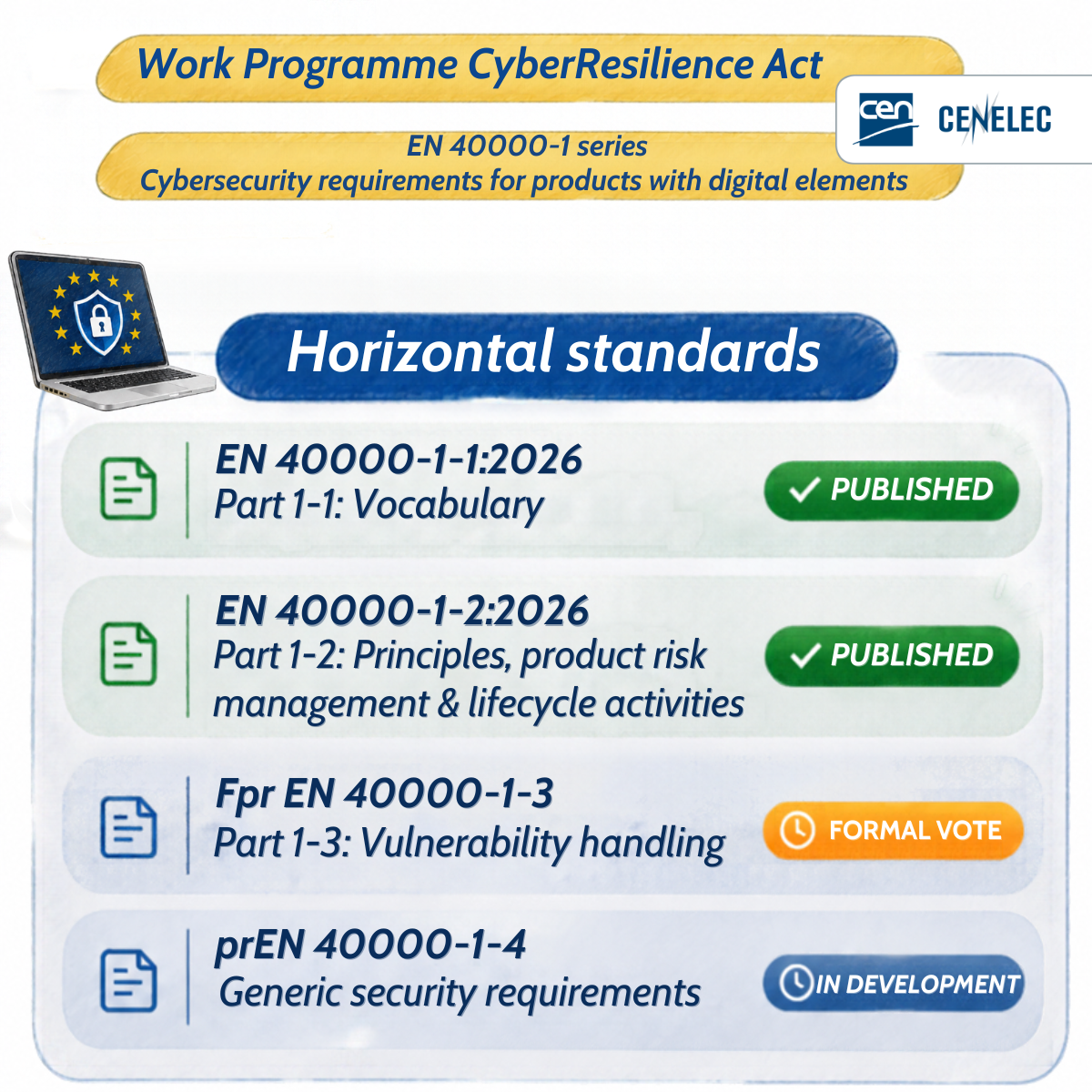
CEN and CENELEC have reached an important milestone in supporting the implementation of the European Cyber Resilience Act (CRA), with the publication of two new European Standards: EN 40000-1-1 on cybersecurity terminology and EN 40000-1-2 on cybersecurity principles, product risk management and lifecycle activities.
These are among the first standards developed under Standardization Request M/606, through which the European Commission has asked the European Standardization Organizations, CEN, CENELEC and ETSI, to develop standards supporting the implementation of the CRA.
The CRA introduces a common European framework for the cybersecurity of products with digital elements, covering a wide range of hardware and software products. It represents a major step towards making cybersecurity an integral part of how digital products are designed, developed and maintained.
Turning these new regulatory requirements into practical standards is an ambitious task. The publication of EN 40000-1-1 and EN 40000-1-2 is therefore an important achievement, establishing part of the common foundations on which further cybersecurity standards will build.
These two standards are part of a much broader programme of work. While they establish a common language and baseline principles for cybersecurity risk management, further standards are being developed to address more detailed cybersecurity requirements, vulnerability handling and the specific needs of different product categories. Together, they will contribute to a coherent European standardization framework supporting the implementation of the CRA.
The standards can be found and obtained through national standards catalogues, subject to the applicable national publication schedules.
A common language for cybersecurity
The first standard, EN 40000-1-1 ‘Cybersecurity requirements for products with digital elements – Part 1-1: Vocabulary’, establishes a common set of terms and definitions for the EN 40000 series.
Cybersecurity brings together experts from many different industries, technologies and professional backgrounds. The same terms may sometimes be understood or applied differently across sectors. A shared vocabulary is therefore essential to ensure that manufacturers, standardization experts and other stakeholders have a consistent understanding of the concepts used throughout the standards.
Although terminology may appear to be a relatively simple starting point, it plays an important role in supporting the consistent interpretation and application of the more technical requirements that follow.
Putting cybersecurity risk management into practice
The second standard, EN 40000-1-2 ‘Cybersecurity requirements for products with digital elements – Part 1-2: Principles, product risk management, and lifecycle activities’, addresses one of the central principles of the CRA: cybersecurity needs to be considered throughout the entire life cycle of a product.
Rather than treating cybersecurity as a final check before a product reaches the market, the standard establishes a common approach to identify, assess and manage cybersecurity risks, from the earliest design decisions through development, production, maintenance and, ultimately, the end of the product's support period and decommissioning.
EN 40000-1-2 establishes a common foundation for cybersecurity risk management, bringing together general cybersecurity principles, baseline requirements for managing cybersecurity risks and activities covering the entire product life cycle. Applicable across a wide range of products with digital elements, it provides a common framework on which more detailed cybersecurity requirements and measures can be built, taking into account the specific risks and characteristics of each product.
This framework also supports the development of other standards under M/606, including those addressing vulnerability handling, generic security requirements and the needs of specific product categories. Together, these standards will contribute to a coherent European standardization framework supporting the implementation of the CRA.
An exceptional collective effort
Behind these publications lies a remarkable mobilization of cybersecurity expertise from across Europe.
The standards were developed within CEN-CLC/JTC 13/WG 9, the Working Group dedicated to horizontal cybersecurity standards for products with digital elements, the Secretariat of which is held by NEN.
The scale of participation reflects the strong commitment of stakeholders, with more than 450 committee members from 28 national standardization organizations and 17 Liaison organizations. Bringing together diverse technical expertise, established industry practices and new regulatory expectations has been a considerable undertaking. The publication of these first two standards reflects this collective effort to turn an ambitious European regulatory framework into practical tools for industry.
This achievement has also benefited from the financial support of the European Union through the European Innovation Council and SMEs Executive Agency (EISMEA), under the STAN4CR action grant. Find more information about the STAN4CR funded activities here.
Building the foundations for a more cyber-resilient Europe
The publication of EN 40000-1-1 and EN 40000-1-2 is an important first step, but the work continues.
Further horizontal standards are being developed to address vulnerability handling and generic cybersecurity requirements, alongside standards covering specific product categories. Together, these deliverables will contribute to a coherent European standardization framework supporting the CRA.
For manufacturers, the availability of these first standards offers an opportunity to become familiar with the common terminology and risk management principles underpinning the new framework, and to begin incorporating them into their product development and cybersecurity practices.
For CEN and CENELEC, these publications mark both a significant achievement and the beginning of a new chapter in European cybersecurity standardization. They demonstrate what can be accomplished through the joint commitment of industry, technical experts, national standardization bodies, European institutions and other stakeholders working towards a common objective: making products with digital elements more secure and strengthening trust in Europe's digital market.
What's next
These publications mark the first milestones in delivering European standards supporting the CRA.
And more are on the horizon: the publication of FprEN 40000-1-3 and the first product-specific (vertical) standards will soon further expand this growing portfolio.