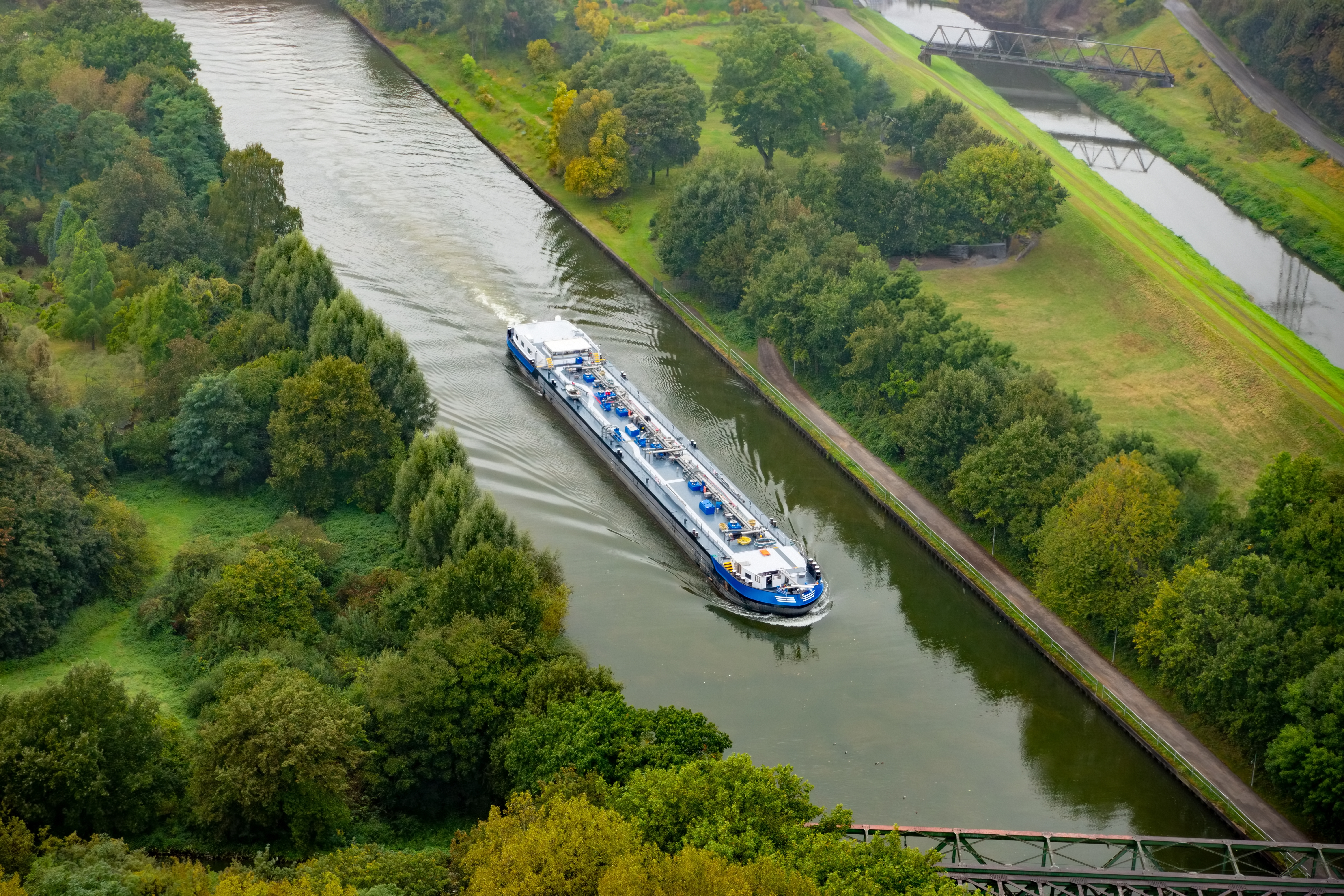
As Europe accelerates its transition toward cleaner transport, inland waterways are expected to play an essential role. One promising solution is methanol, a fuel that can be produced from renewable sources and that burns more cleanly than traditional fuels. To support its safe uptake, CEN/TC 15 ‘Inland Navigation Vessels’ has developed EN 18071:2025 ‘Inland navigation vessels – Methanol bunkering’, a new European Standard that sets out clear technical and operational requirements for refuelling vessels with methanol.
This new standard is an important contribution to the European Union’s climate ambitions. It supports Standardization Request M/581 and the Alternative Fuels Infrastructure Regulation (EU) 2023/1804, both of which call for harmonized interoperability frameworks to enable wider deployment of low-carbon energy in transport.
Methanol offers many environmental advantages, but handling it safely requires specific procedures due to its particular properties, such as its low flashpoint, corrosiveness, and the fact that its flames may be nearly invisible in daylight. EN 18071:2025 addresses these challenges by providing a harmonized set of rules that ensure bunkering operations are carried out with the highest levels of safety, reliability, and interoperability across Europe’s inland waterways.
The new standard covers the entire bunkering chain. It defines requirements for the design of transfer systems, including hoses, flanges, emergency shutdown devices and vapour-management systems. It also specifies how bunkering equipment must be inspected, maintained, and identified so that both suppliers and vessel operators can work with full confidence in the systems they use.
Beyond technical components, EN 18071:2025 places strong emphasis on operational safeguards. It introduces detailed procedures for risk assessment, mooring arrangements, communication protocols and pre-transfer safety checks. During bunkering, dedicated supervisors, manifold watchkeepers, and hose watch personnel ensure continuous monitoring and the ability to activate the emergency shutdown system at any time. To facilitate consistent practice, the standard provides a complete series of methanol bunker checklists, covering planning, pre-operations, transfer, simultaneous activities, and post-transfer verification.
EN 18071:2025 also recognizes that safe bunkering depends on well-trained personnel. The standard therefore requires crew and facility operators to meet competence criteria defined in the European Standards for inland navigation qualifications (ES-QIN) and to receive additional methanol-specific training. At the end of each operation, a standardized Bunker Delivery Note documents the fuel’s quality, composition, and quantity, ensuring full traceability.
By providing clear, practical, and safety-oriented rules, EN 18071:2025 helps ports, vessel operators, and fuel suppliers adopt methanol with confidence.
It demonstrates once again the essential role of European standardization in enabling innovation and supporting cleaner, safer, and more efficient mobility on Europe’s inland waterways.