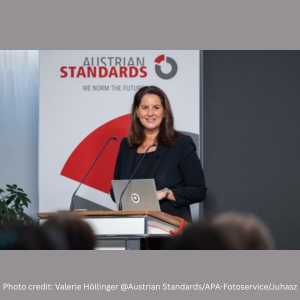
More than 1,000 interested parties from the European Commission, businesses, administration, science, and civil society reinforced how central standardization is as a lever for innovation and competitiveness. Over three days, the WE NORM THE FUTURE | Summit 2025 covered a wide range of topics, from expert talks on the European standardization strategy and circular economy to the annual construction conference. All formats focused on dialogue: intensive discussions were held along the entire value chain on how complex future issues can be translated into viable solutions with the help of standards.
The update on the start of the summit, including the Expert Talks on the European Standardization Strategy, was included in the November issue of On the Spot.
The second major pillar of the summit program focused on circular economy. Under the title “Circular by Standard: Innovation through Standardization, Eco-design and Digital Product Passports,” discussions explored how regulation can be translated into tangible opportunities for new business models. A central theme was the Digital Product Passport (DPP), which enables transparency across the full product life cycle, from raw materials and production through use to recycling. Companies from a wide range of industries shared how they are already using standards to build circular business models, from durable quality fashion to industrial material cycles.
Annual Conference on Building Standards: Climate-friendly, digital, affordable
The summit concluded with the Annual Construction Conference 2025. The event offered a broad overview of an industry in which climate neutrality, digitalization, and affordability are among the key challenges. Contributions ranged from hard data on the rising number of hot days in Vienna to new standards for green roofs, from the question of insurability in the built environment to a reality check on the actual impact of standards on project costs and where other factors play a much bigger role. The construction sector illustrates how closely regulatory requirements, standards, financing, and risk management are intertwined. A recurring point from both the panels and the audience was that standards provide guidance in an environment where climate requirements, energy targets, and economic pressure are all increasing at the same time.
Summary
“Without standards, we are stuck with isolated solutions. With standards, we create networks. In a highly networked world, this is one of our most important assets,” Valerie Höllinger emphasized in her concluding remarks on the summit.
WE NORM THE FUTURE | Summit 2025 demonstrated that when Europe takes its role as a global standard-setter seriously, standardization can become a catalyst for innovation, climate action, and competitiveness, while also providing guidance in an economy where complexity has become the new normal.