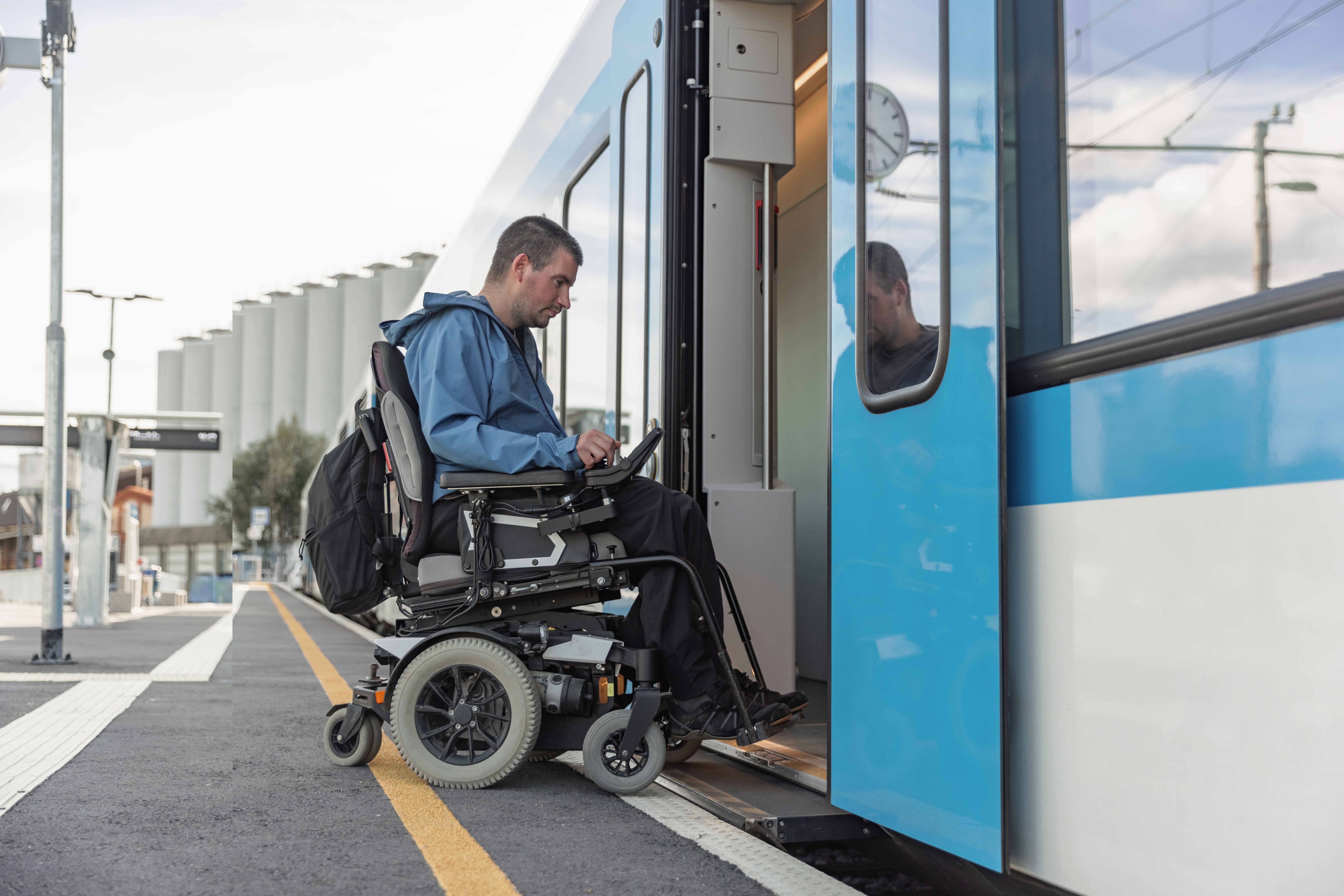
Every day, millions of people rely on Europe’s rail network. For many, travelling by train is simple and routine. But for passengers with disabilities or reduced mobility (PRM), even minor obstacles – unclear signs, narrow doors, steep steps, or slippery surfaces – can make a journey difficult or even unsafe.
To address these challenges consistently across Europe, CEN/TC 256 ‘Railway Applications’ has developed a comprehensive suite of nine new European standards dedicated to accessibility. Together, they form a complete and harmonized framework to ensure that stations, platforms, and trains are designed so that everyone can travel independently, safely, and with dignity. These standards support the EU’s PRM Technical Specifications for Interoperability (TSI) and represent a major step towards inclusive rail mobility across the continent.
The standards address both infrastructure (stations and platforms) and rolling stock (trains), covering everything a traveller encounters, from entering a station to boarding, using onboard facilities and alighting.
1. Clear visibility and accessible information
The first group (EN 16584 series) sets out essential principles for a user-friendly rail environment.
Contrast
Visual contrast helps passengers identify doors, handrails, steps, and platform edges. This is vital for visually impaired travellers but benefits everyone by improving overall visibility.
Information
Signs, pictograms, printed notices, digital displays, and audible announcements must be readable, consistent, and positioned at accessible heights.
Lighting and surface safety
Stations and trains must offer appropriate illumination and slip-resistant walking surfaces. Transparent obstacles such as glass doors must be clearly marked.
These requirements make stations and trains easier to navigate, reducing confusion and making passengers feel safer and more confident during their journey.
2. Accessible onboard spaces and facilities
Three standards (EN 16585 series) focus on the interior of trains.
Toilets for all passengers
Where toilets are provided, at least one must be fully wheelchair accessible. The standard defines clear manoeuvring space, placement of handrails, contrasted surfaces, reachable controls, and the presence of two call-for-aid devices.
Seating, handrails, and wheelchair spaces
The standards set rules for more comfortable and safer travel:
- At least 10% of seats must be priority seats.
- Handrails and handholds must be easy to grip and positioned where support is most needed.
- Wheelchair spaces must respect specific dimensions and include a companion seat and accessible controls.
Corridors and internal doors
Interior circulation must allow PRM passengers to move freely. Corridors require clear widths and turning spaces, while doors must be operable with limited force, visually identifiable and wide enough for independent access.
Overall, these measures ensure that train interiors are easy to navigate and usable for everyone.
3. Safe and independent boarding
Boarding and alighting can be the most difficult part of the journey for PRM passengers. The EN 16586 series addresses this critical part of the journey.
Steps
The standards define maximum step height, depth and width, along with mandatory contrasting markings. These requirements help passengers safely identify and negotiate changes in level.
Boarding aids
When the gap between the platform and the train is too large, boarding aids must be provided. These include ramps, lifts, bridging plates, and movable steps. The standards describe in detail:
- maximum allowable slopes,
- minimum widths,
- slip-resistance,
- safe operating speeds, and
- necessary manoeuvring spaces for wheelchair users.
4. Obstacle-free routes in stations
The final standard, EN 16587, defines what an accessible route through a station should look like.
Key requirements include:
- minimum corridor widths (1.6 m) and headroom (2.1 m),
- contrasted and tactile warning indicators on stairs, ramps, and platform edges,
- accessible ticketing desks, including induction loops for hearing-impaired passengers,
- platform safety zones, with clear warning lines at least 100 mm wide and tactile surfaces, and
- safe level crossings with controlled gradients and wheel-friendly surface gaps.
The aim is to ensure that all passengers, regardless of ability, can move smoothly from the station entrance to the platform without encountering hidden obstacles.
Setting a new benchmark for inclusive mobility
Together, these nine standards give Europe one of the world’s most complete accessibility frameworks for rail transport. As seen in other areas, from space systems to emerging technologies like hyperloop, standardization plays a crucial role in ensuring safety, reliability, and technological progress.
By implementing the PRM standards, infrastructure managers, train manufacturers, and operators can significantly improve the travel experience. The benefits extend well beyond PRM passengers to families with strollers, elderly travellers, passengers with luggage or temporary injuries, and tourists unfamiliar with their surroundings. All gain from clearer information and safer, more intuitive environments.