Young professionals bring new energy, ideas, and skills to European standardization. As Europe undergoes rapid transformations, their contributions are key to ensuring that standards remain relevant, forward-looking, and impactful.
In the context of the green and digital transitions, and as Europe strengthens its efforts to build a skilled and future-oriented workforce, we are continuing our interview series dedicated to young professionals. Through conversations with young professionals working in standardization across different sectors and countries, we highlight their experiences, motivations, and visions for the future.
This campaign aims to shed light on the vital role of skills, collaboration, and innovation in keeping European standardization fit for tomorrow’s challenges – and on the people who are already helping to shape it.
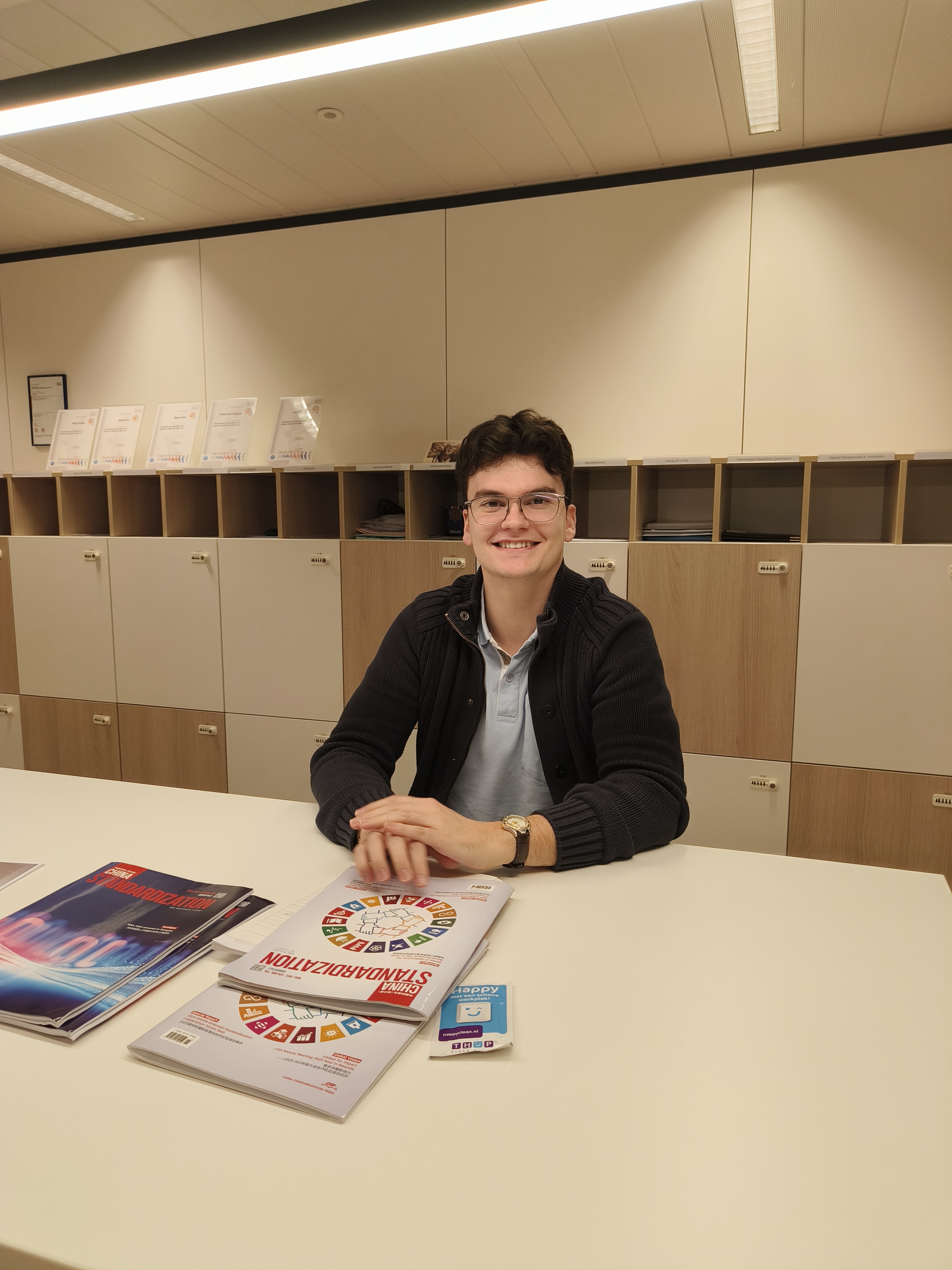
For the sixth episode in this year’s interview series, we spoke with Enguerrand Crouzet, currently studying at EPF Engineering School. Enguerrand completed a four-month internship at CCMC, where he worked, among other tasks, on a study related to CEN and CENELEC Workshop Agreements. He shares his experience, his perspective on the value of standardization, and what it is like to be a young professional in this field.
1. Please, present yourself. How are you involved in standardization?
I am a fourth-year student at EPF Engineering School in Montpellier, currently completing a four-month internship at the CEN and CENELEC Management Centre (CCMC). I work within the Mobility team, contributing to European standardization activities in the field of mobility. Originally planned as an international placement, this internship has given me direct insight into how European standards are developed in practice.
2. How did you become interested in standardization?
Before my internship, my understanding of standardization was limited, as my engineering curriculum mainly focused on technical and scientific aspects. However, I often heard that many key decisions were taken in Brussels, which sparked my curiosity.
By joining CCMC, I gradually discovered the scale of the European standardization system and its essential role in ensuring the smooth functioning of the European market. I came to realize that standards are not merely technical documents, but powerful tools for harmonization, safety, and innovation. This experience helped me understand their concrete impact on industries, public policies, and, in the long term, on the daily lives of European citizens. It is this combination of technical depth, strategic relevance, and European dimension that truly drew me into the world of standardization.
3. You are interested in Energy, Environment and Natural Resources. Can you explain a bit what you have been working on recently?
I had the opportunity to work on two standardization projects closely linked to my specialization in energy and environment.
The first focused on Onshore Power Supply (OPS) for inland navigation vessels. It involved analyzing gaps between EN 15869 and EN 16840 to improve interoperability and support the reduction of port-side emissions such as NOx and particulate matter.
The second project addressed emerging nuclear technologies, with a focus on Small Modular Reactors and Molten Salt Reactors. I examined how existing EN and IEC standards could be adapted to support these low-carbon solutions while ensuring high levels of safety and modularity.
Overall, these projects strengthened my understanding of how standardization can guide technological innovation while aligning with European environmental objectives.
4. In your experience, how can standardization play a role in addressing the major challenge of sustainable development? Why are standards important in this context?
Standardization plays a key role in addressing the challenges of sustainable development, as it translates environmental ambitions into concrete, shared, and scalable technical frameworks. By providing a common language for industry, public authorities, and end users, standards facilitate the uptake of sustainable solutions while ensuring safety, reliability, and interoperability.
In the energy sector, this approach is particularly critical for low-carbon technologies with systemic impact. Nuclear energy is a prime example. Next-generation reactors, such as Small Modular Reactors and Molten Salt Reactors, offer strong potential to deliver reliable, low-carbon electricity with enhanced safety characteristics. However, their deployment depends on the availability of robust standards covering safety, materials qualification, and lifecycle aspects. By structuring innovation and reducing technical uncertainty, standardization helps build trust, supports investment, and enables nuclear technologies to contribute effectively to Europe’s energy transition.
5. More generally, in the current geopolitical context, sustainability is sometimes put aside. How do you view Europe’s role in the global landscape? What are its strengths and where could it improve?
In the current geopolitical context, Europe has chosen sustainability as a strategic differentiator rather than a short-term power lever. This is both its main strength and its main weakness.
Europe’s strength lies in regulation, standards, and long-term vision. The Green Deal, carbon pricing, and environmental norms shape global rules and influence supply chains far beyond Europe. Europe also has strong industrial know-how in renewables, grids, energy efficiency, and clean technologies.
However, Europe faces challenges in execution. Energy prices remain high, grids are underdeveloped, and electrification is progressing too slowly. This weakens industrial competitiveness and slows adoption, pushing consumers and firms to remain dependent on gas or grey hydrogen.
To improve, Europe must complement its green ambition with pragmatism. Faster infrastructure rollout, cheaper low-carbon energy – including nuclear –, and a stronger industrial policy are needed. Sustainability must become a growth engine, not a constraint.
6. What was your experience in CCMC? In your experience, what is the real value of the European standardization system – particularly when it comes to emerging technologies?
During my internship at CCMC, I gained a behind-the-scenes understanding of how CEN-CENELEC Workshop Agreements are developed and how they interact with the work of Technical Committees. This experience highlighted both their strong potential and the fact that they are sometimes underused. I was particularly struck by the responsiveness and flexibility of the CWA process, which makes it possible to address emerging technologies well before formal standards are available.
What stood out to me most was that the real value of European standardization lies not only in the standards themselves, but in the ecosystem behind them. By bringing together industry, research, and public authorities within a trusted framework, the system enables technical consensus and market coherence. In fast-evolving fields such as sustainable fuels, hydrogen, or smart mobility, this approach ensures interoperability, credibility, and cross-border alignment.
Standardization is not just documentation, but a strategic enabler of innovation with real-world impact.
7. In your opinion, what can CEN and CENELEC as ESOs do to improve the participation of young people in standardization?
Raising awareness among young people about standards and regulation is essential, as these frameworks directly affect safety and reliability in everyday life. Yet the role of European regulation and standardization remains largely overlooked in current education systems.
At the secondary education level, a first approach could focus on the philosophy behind regulation, which aims to protect users while encouraging European companies to develop safe, durable, and high-quality products. It is also important to convey that these requirements have a cost and are closely linked to research and innovation.
At the higher education level, the focus should shift toward future engineers and technical experts. From my own experience as an engineering student, standardization is rarely addressed in curricula, although it plays a key role in real-world engineering practice. Dedicated modules would better prepare future professionals to engage effectively in standardization and contribute to Europe’s technological excellence.
8. What advice would you like to give to your fellow young professionals to invite them into the world of standardization?
I would first stress the importance of understanding the very concrete impact of standards. Standards are not abstract documents: they shape markets, influence industrial choices, and directly affect citizens’ daily lives. Better awareness of these issues earlier in education would help future professionals grasp the strategic role of standardization and engage with it more confidently.
Taking part in standardization is both an opportunity and a responsibility. It is essential to understand who you represent, to act with integrity, and to keep the collective interest in mind. From a practical perspective, I would also encourage active involvement, particularly through attending meetings in person, as this helps build trust and long-term cooperation. Standardization relies as much on technical expertise as on dialogue and sustained collaboration.
This article is part of our special series dedicated to Young Professionals in European Standardization. Through a series of interviews with standardization professionals, experts, and business leaders from a variety of backgrounds, we explore the interaction between innovation, skills, and standardization in some of the most relevant sectors for Europe’s long-term competitiveness. You can read the other articles in the campaign here.