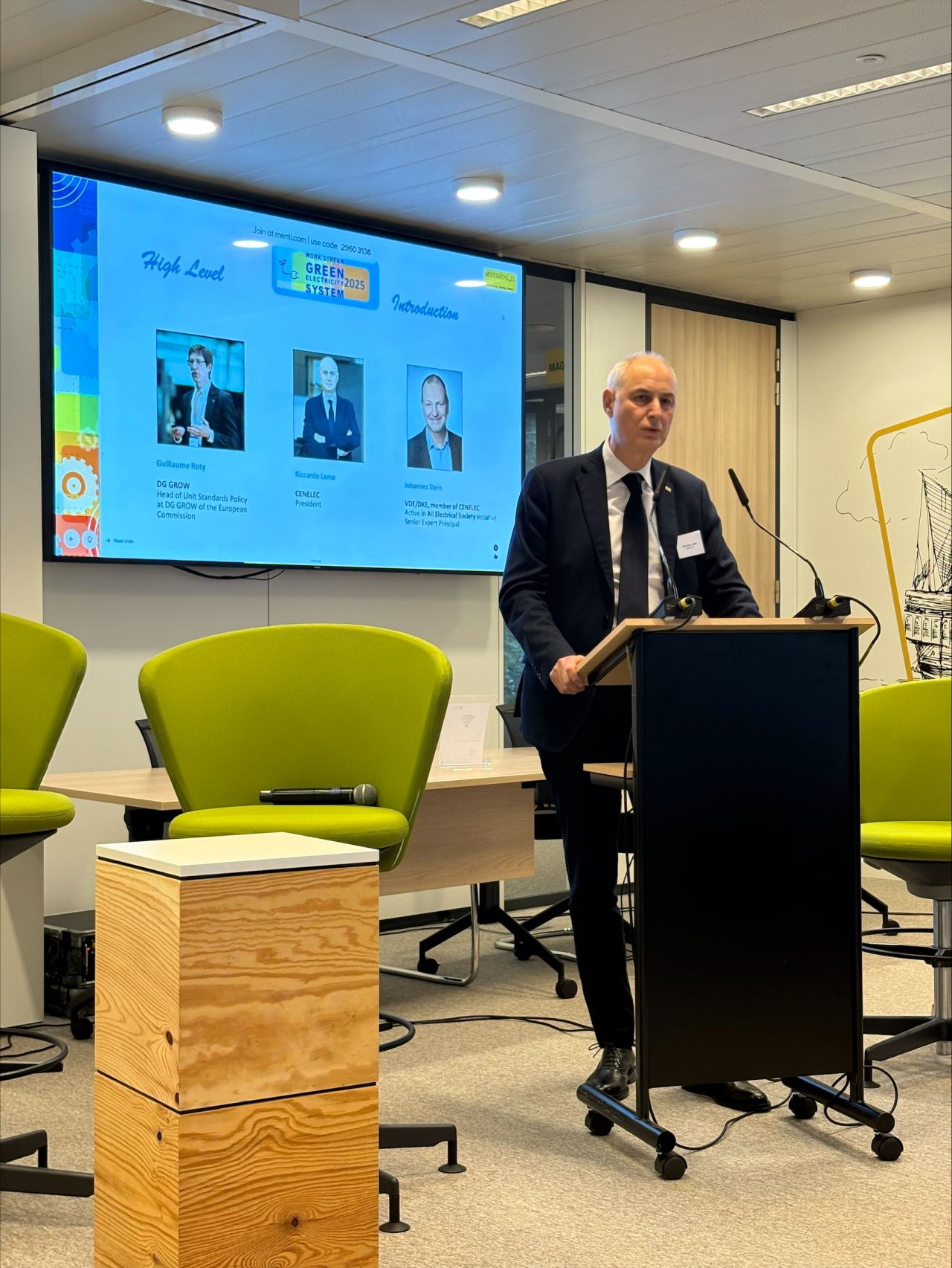
On 24 November 2025, a high-level event in Brussels brought together policymakers, industry leaders, grid operators, standardization bodies, and researchers to examine how Europe’s electricity system can evolve from a focus on decarbonization alone towards long-term resilience, competitiveness, and security. Against the backdrop of rapid electrification and growing system stress, the event ‘Green Electricity Systems and Beyond: From Climate Goals to Systemic Resilience’ explored how, while the energy transition is advancing, it now faces a more complex and demanding phase.
The event was moderated by Rogier Elshout and kicked off with an introduction from Yann Fromont, Deputy-President of T&D Europe, and a welcome speech by Cinzia Missiroli, Acting Director General of CEN and CENELEC. In his keynote speech, Guillaume Roty, DG Grow Head of Unit, emphasized the importance of European standardization as a strategic tool for EU competitiveness and the green transition. Riccardo Lama, CENELEC President, highlighted how crucial aligning closely with international standards is, and he focused on turning strategy and standardization into concrete action on the ground. The third keynote speech was given by Johannes Stein from VDE, introducing the All-Electric Society as Europe’s emerging next industrial revolution.
Next, Diederik Peereboom (T&D Europe), Helena Le Goff-Jedrzejowicz (Europacable), and Rémy Garaude-Verdier (Enedis) gave an executive summary of the 2025 HLF Workstream 9 works. The discussion highlighted that Europe’s electrification challenge can only be addressed through a coordinated, system-wide approach that brings together industry, grid operators, policymakers, and standardizers. The speakers underscored that standards are a practical enabler, crucial for turning policy ambitions into real-world deployment by ensuring interoperability, safety, and efficient processes. They agreed that standardization is a strategic driver of European competitiveness, helping align stakeholders, prioritize innovation, and accelerate delivery of the energy transition.
The panel discussion “What are the next challenges facing the electricity system in 2026–2028?” gathered Gilles Nativel (Enedis), Miha Bobic (EU.Bac), Veerle Beelaerts (EHI), and Natalie Samovich (AOITI), who discussed how the success of Europe’s electrification depends on close coordination among all stakeholders, using a system-level approach rather than isolated solutions. The speakers highlighted that standards, covering both products and processes, are essential to translate policy goals into practical implementation, from grid connections to public procurement. The discussion confirmed that standardization is not merely technical work but a strategic tool for competitiveness, innovation, and effective delivery of the energy transition.
The second panel discussion explored the question of “Is electricity resilience compatible with climate change, electrification, renewables?” and involved Cedric Giraud (TSO-RTE), Catarina Augusto (Solar Power EU), Omar Dhaher (Digital Europe), and Klaus Wolfgang (Orgalim). The speakers agreed that resilience is multi-dimensional, covering climate, cybersecurity, supply chains, infrastructure, and operations, and that flexibility, digitalization, and forecasting are the most critical priorities to strengthen Europe’s electricity system. Standardization was repeatedly highlighted as the key mechanism to align stakeholders, define common concepts (such as resilience and flexibility), integrate new technologies into legacy infrastructure, and deliver solutions faster. Overall, the conversation emphasized urgency: Europe cannot choose between climate goals and resilience, but must “walk the talk” by accelerating coordinated action, breaking silos, and turning shared priorities into implementable standards.
Vincent Berrutto, Head of Unit of DG ENER, Luka De Bruyckere, Senior Program Manager of ECOS, and Yann Fromont, Deputy-President of T&D Europe, gave the closing remarks. The event concluded with a shared understanding that Europe’s clean energy transition will only succeed if technical innovation, standardization and policy move forward together, transforming electricity from a collection of components into a resilient, future-proof system.